Summary by: Jaymani Sevanathan
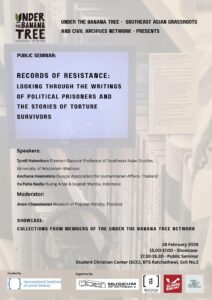
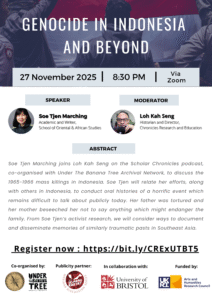
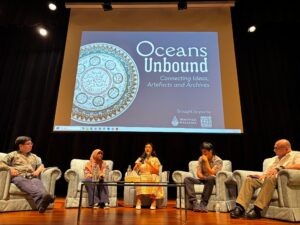
Archiving Mo(ve)ments: Archival Praxis as Social Movements was the theme of a webinar held on 19 June 2025 by Pusat Sejarah Rakyat (PSR), an independent historical initiative focusing on the people’s history of Malaysia and Singapore. PSR is also part of the regional based Under the Banana Trees Archival Network; a regional consortium of organisations devoted to the preservation of people’s histories.
As part of the consortium’s inaugural webinar session, it brought together two speakers, Brenda Danker from Malaysia’s Freedom Film Network (FFN) and Adrian Mendizabal from the Philippine Labour Movement Archive (PLMA) to explore how grassroots archival initiatives serve as dynamic political and pedagogical tools in Southeast Asia.
Zikri Rahman, the moderator, opened the session by quoting Vladimir Lenin: “There are decades where nothing happens and weeks where decades happen” as a reminder of how tremendous historical shifts can be.
It was within this context that Brenda introduced FFN’s initiative in the form of Arkib Filem Rakyat (People’s Film Archive). As a long term project, it documents Malaysia’s social justice movements using audiovisual materials dating back to the 1990s. Rare video footage of the Reformasi movement, anti-GST marches, Indigenous land rights demonstrations, and series of BERSIH electoral reform rallies can be found in its repository. Additionally, it contains more than 60 social justice documentary films that have been produced since 2003 as part of the Freedom Film Fest. FFN presents the archive as a place to gather “history from below,” elevating the voices of people who are frequently marginalized or erased from national memory, in contrast to traditional archives that frequently support institutional narratives.
Adrian, on the other hand, situated the PLMA’s initiative from the perspective of a recent project that was established in 2022 in reaction to political misinformation and Ferdinand Marcos Jr.’s election. The majority of the items in PLMA’s collection are photographs, including publications, union materials, and strike images from the 1980s to the 2000s. The archive contains ranges of records and incidents from elections, oil cartel protests, mall workers’ strikes, and labor resistance throughout martial law’s period. Driven by volunteer archivists, students, and employees that worked together in creating the space and its digitization effort, it is instrumental in expanding the project.
Archives are not impartial repositories, as both presenters made clear. Instead, it acts as a means of political interventions. Archiving is positioned by Brenda and Adrian as a process of movement-building, memory work, and resistance. FFN challenges the prevailing historical narratives, encourages civil action, and educates the youth through its archives. Archival materials are viewed by PLMA as living records of struggle, instruments for reclaiming lost histories and inspiring new generations of labourers.
Documentation created by the community became a fundamental idea for both organisations. Brenda emphasized that a large number of videos in Arkib Filem Rakyat were produced by activists and community organizers rather than by professional crews; hence multiple qualities and ‘rawness’ of its aesthetics in capturing the moment. State archives, to a certain extent, are unable to capture the immediacy of documentations like these, particularly in the form of unvarnished and emotionally charged materials usually do. Adrian pointed out that a wide range of volunteers, including memory workers, trade unionists, and students, collectively curate PLMA’s holdings. Their democratic and decentralized model is based on the idea that history is made by the people.
Outreach and education were the major topics presented. Through social media, “react videos,” and screenings that cut across generational boundaries, FFN engages with multiple demographics, particularly youth. In one instance, young Indigenous women’s reflection videos were shown after a series of archival footage of a historic Orang Asli protest for land rights from 2010. These interactions foster intergenerational history-making and affirm that struggle is a continuous process. On that note, in order to return historical materials to the people who created them, PLMA also hosts film screenings, discussion circles, and field trips to union communities. Actively intervening in diversifying the documentation process, PLMA organised photography workshops to ensure the continuity of building historical engagement with the intersectoral community that they are building together.
In both projects, archival public activation is essential. Brenda talked about FFN’s partnership with the “Strategies of Dissent” exhibition in Kuala Lumpur, where visitors were emotionally and historically anchored by striking video of 1998’s Reformasi era in Malaysia. Adrian explained how PLMA approaches the questions of archival memory right into the streets, where a plethora of actions are happening, through its mobile exhibitions, which are illuminated photos carried during protests or vigils. These public displays are protests in and of themselves, in addition to being pedagogical.
Technological and logistical issues were also discussed. Brenda talked about the arduous process of digitizing and cataloguing more than 30 years of unprocessed video, frequently with little funding. Adrian talked about the pressing need for PLMA to preserve old photos, many of which are already deteriorating. Both speakers view their work as extremely meaningful despite these limitations, a labor of love and defiance that provides fresh resources for upcoming educators and organizers.
Participatory approaches to archival work are emphasized in both archives. In order to promote collective ownership of history, PLMA organizes “archiving days” where volunteers assist with digitizing materials. In addition to enhancing community capacity, this approach guarantees that the archive stays rooted in the real-life experiences of the people it aims to represent. In order to ensure that historical lessons inform contemporary activism, Arkib Filem Rakyat works with educators and artists to incorporate archival footage into workshops. The communities whose histories are being preserved are frequently left out of traditional archival practices, which are challenged by these collaborative models.
One of the participants asked the speakers a two-part question during the Q&A session, focusing on whether their collections cover environmental struggles, especially those related to just energy transition, and how archival work affects youth political awareness. Speaking about the Philippine context, Adrian Mendizabal admitted that the Philippine Labour Movement Archive (PLMA) is still in its infancy and that, although many Filipinos, including activists, are still unaware of historical figures such as labor leader Ka Lando Olalia, the archive is progressively closing this gap through social media engagement, public education, and records of labor participation in national elections. Adrian observed a startling increase in support for candidates with a labor affiliation, indicating that awareness is spreading outside of the activist milieus. Responding to the environmental archiving, he explained that although PLMA contains some records of protests against globalization and the environment in the 1990s, the majority of the materials now pertain to industrial sectors like semiconductors, textiles, hotels, and shopping centers.
Brenda Danker offered a Malaysian viewpoint, emphasizing how censorship has stoked young people’s desire to unearth histories that have been suppressed. She pointed out that a lot of young people show a keen interest in learning about historical movements at FFN events and university lectures, and FFN uses art, film, and social media to make these discussions more approachable and pertinent for younger audiences. It is pertinent to note that the FFN’s archival materials are utilised for documentary making purposes which highlights the generative aspect of archiving.
The efforts of PLMA and Arkib Filem Rakyat demonstrate that archives serve as critical tools for influencing the future as well as for conserving the past, particularly in the movement making process. These programs make sure that historical struggles are remembered by documenting resistance, encouraging future generations to carry on the struggle for justice.These archives are acts of resistance in an area where historical revisionism and authoritarianism threaten democratic memory. They serve as a reminder that tomorrow’s movements will be fueled by the stories we preserve today. Supporting such initiatives is not to be perceived as an isolated academic exercise but also as a contested site of meaning-making in the democratisation process.