Summary by; Abdul Rahman Shah
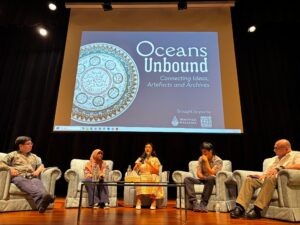
The session begins with the moderator, Yvonne Tan, introducing Amos Ursia from Kolektif Arungkala. Founded in 2019, the collective engages in memory-based research, experimental historiography, community archiving, and participatory performance. Some of their on-going projects are Museum Orang Biasa (Museum of Ordinariness), Anti-Tour Project, and Walk The Past Platform.
Amos explains that Arungkala started as a university study group of history students who felt constrained by Indonesia’s official narratives and historiography. Most were trained under the social history model at Gadjah Mada University (UGM), but they wanted to move beyond state-centered and military historiography shaped by the Suharto era. The group sought to reclaim history from below by exploring community memory, emotion, and postcolonial knowledge. For them, history is not only what is written, but what is felt, remembered, and shared.
Arungkala merges art and research to create living archives. Influenced by artists-theorists such as Tania Bruguera and Tanqua Verghese, the collective views artistic practice as a tool for knowledge production and historical inquiry. In Indonesia, history is often limited to books and academic writing. Arungkala expands this by using performance, walking tours, and zine-making to democratize history-making and invite the public into the process.
To illustrate their approach, Amos shares a personal story from his family’s roots in Suruwa Island, Maluku, whose ancestors fled Banda Island after the 1621 Dutch VOC massacre. His uncle once told him to “sit on the shore and let the ancestors come to you,” suggesting that understanding history requires listening through the body. He describes a ritual of “swallowing spit while looking at the island,” symbolizing ancestral protection. This story shows how embodied rituals and oral traditions function as living archives, holding knowledge beyond what written history captures.
Amos explains that for Arungkala, emotions, gestures, and memory are essential parts of historical knowledge. To reclaim history, they challenge conventional archives that privilege official voices. Everyday acts, songs, and local memories are treated as valid sources of history. Their approach decentralizes authority, making space for feelings and lived experience as part of Indonesia’s broader historical consciousness.
Arungkala’s projects often involve collaboration with villagers, women, and youth. Through workshops and zine-making sessions, communities document local stories, recipes, and oral histories. In the Kendeng Mountains, the group works with young environmental activists resisting land exploitation, helping them record ecological and cultural knowledge. These participatory archives are shaped by the communities themselves, turning archiving into a shared act of storytelling rather than an extractive research process.
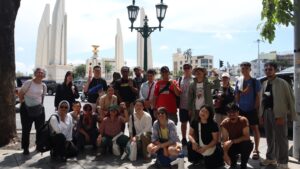
In another exploration, the collective’s Anti-Tour Series transforms the city of Yogyakarta into a living classroom. Participants walk through historically charged sites like military monuments and uncover suppressed stories and collective memories. In 2023, Arungkala collaborated with the Ibu-ibu Dialita Choir, women who survived the 1965 anti-communist purges, to stage walking performances that merged oral testimony with public ritual. These tours invite participants to challenge official history while creating a shared emotional connection to the place.
Amos highlights the Museum Orang Biasa, a mobile museum that travels through markets and public spaces. It features stories of vendors, farmers, and laborers whose lives rarely appear in formal history. This project critiques Indonesia’s state museums, which often serve as propaganda tools. By celebrating everyday people, Arungkala turns museum-making into a communal act, proving that history also lives in marketplaces, conversations, and memory.
Part of the Museum, one example reactivates a forgotten colonial tragedy. Participants stood under a Dutch-era bridge in Yogyakarta and read a century-old newspaper story about a woman named Golo who was hit by a train. As a train passed overhead, her story was spoken aloud, transforming the site into a living memorial. For Amos, this moment captured what Arungkala strives for: history that can be felt, heard, and collectively remembered.
To conclude Amos criticises Indonesia’s state-led historical programs, which continue to impose top-down national narratives. Arungkala’s goal is to restore history to the people, encouraging participatory and community-based storytelling that resists state control.
The moderator ends the session by commending Arungkala’s contribution to public history and decolonial practice in Southeast Asia. She notes that the collective’s projects redefine archives as living, emotional, and communal rather than institutional or static. The discussion concludes with gratitude from the audience and recognition that Arungkala’s work demonstrates how art, empathy, and humor can rebuild historical understanding and collective identity in Indonesia.
Participants engagely asked about the risks of political sensitivity, engaging rural communities, the role of emotion, and how Arungkala handles conflicting memories. Amos explains that the collective relies on artistic sensibility and indirect storytelling to navigate political restrictions, using zines, sound, and visual metaphors to reach audiences safely.
He adds that working with villagers requires building trust and friendship, not imposing certain frameworks or approaches. When facing conflicting memories, as in a case in Kudus, a regency in Central Java, where both perpetrators’ descendants and victims’ families shared stories, the group emphasizes empathy and lived experience over judgment. Lestari, another member of Arungkala, also elaborates that their zine-making workshops allow people to write in their own voices, often messy and emotional, resisting institutional editing. Other questions explore the collective’s long-term vision and use of humor in its praxis.
Amos says humor and irony are strategic tools in Indonesia’s tense political environment, citing Pameran Arsip Sejarah Gerakan Perempuan, a collaborative exhibition with Perempuan Mahardhika, where visitors walked across fake Suharto rupiah notes to reach an image of labor activist Marsinah. Through its multiple exploration, Arungkala transforms history into an act of politics of care which embeds participation in making the memory accessible and alive.