Summary by; Abdul Rahman Shah
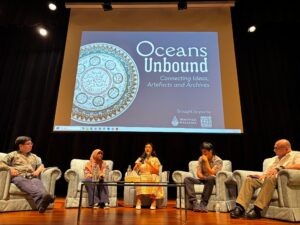
The session opens with an introduction to Plantation Afterlives: Songs, Memories, and the Politics of Care, a conversation centered on the filmmaking practices exploring songs, memory, oral traditions, and the worlds of Tamil plantation histories by the moderator Barathi Selvam. He also added a personal anecdote on how his family came to Malaya and settled in an estate in Cameron Highlands.
The moderator then introduces filmmaker Gogularaajan “Gogu” Rajendran, whose documentary Araro Ariraro explores indentured laborers and plantation folk songs through a mix of humor, horror, and poetic imagery. Alongside him is Noor Netusha Nusaybah, a researcher and co-founder of Imagined Malaysia, whose work situates these artistic explorations within broader histories of colonial migration, political economy, and archival silence.
To begin, Gogu shares a Tamil folk song once sung in Malaysian plantations during the early waves of Indian migration. Through only a few lines, the song reveals layered histories of movement, gendered labor expectations, and exploitation. This becomes the entry point into a wider reflection on folk songs as repositories of lived experience and emotional memory.
He explains how he traveled to meet older singers who helped him reconstruct about thirty songs from an archive of hundreds. Included in his research is a book by the late professor R Dhandayutham entitiled “Malaysia Naatuppura Paadalgal” (Malaysian Folk Songs) which contained over 500 folk songs. He describes these works as a “frozen archive,” containing dormant knowledge that can resurface through careful listening, collaboration, and performance. His aim is not only to document these songs but to keep them culturally alive.
He then reflects on his own family history. As a fourth-generation descendant of plantation workers, he grew up with stories about the Brooklyn Estate in Banting, where his father’s generation was the first to leave estate life. For the documentary, he returns to the estate with reconstructed songs and invites his aunts and uncles to perform them on the land where they were once sung. Only half of them agree, showing how emotionally charged this return remains for some family members.
To show how sound reveals history, he presents one of the documentary’s central pieces: Confession of a Woman. He walks the audience through the narrative, singing translated segments. The song follows a woman at dawn, appearing unmotivated yet carrying deeper emotional and physical burdens. Through her voice, the song conveys exhaustion, labor expectations, and unspoken trauma, illustrating how plantation stories often survive through personal storytelling rather than written records.
A particularly powerful moment occurs during the reenactment of a scene, when one of his aunts suggests an alternate ending. After filming, she breaks down, admitting she saw her own father in him. This moment reshapes their family relationship, revealing how intergenerational history can surface physically and emotionally when people are given time and space to engage with it.
Netusha then places these stories within a broader historical framework. She traces Tamil and South Indian migration into Malaya to British expansion across the Bay of Bengal. After slavery’s abolition, indenture emerged as a new system of bonded labor, binding workers through contracts, debt, and coercion. Plantations in Malaya were known for their brutality, often compared to Caribbean slave estates. In these conditions, songs became embodied archives of dignity, grief, memory, and resistance, especially when official documents silenced or distorted workers’ voices.
She explains that mortality rates on plantations were extremely high, with many workers dying from disease, malnutrition, and abuse. Oral traditions preserved what the written archive tried to bury. In bringing these songs back into family and community spaces, the filmmaker creates avenues for emotional processing and intergenerational healing.
On the other hand, Gogu adds that during production, he encouraged his relatives to begin each day with meditation. His refrain, “Our ancestors are living in our body. They are singing. Let them sing,” became the project’s guiding philosophy, emphasizing that history often resides in the body and emerges through collective ritual and sensory engagement.
The moderator introduces Mina, a comic banned in the 1980s for depicting child labor and sexual violence on plantations. Its themes highlight how plantation narratives are deeply intersectional, involving caste hierarchies, gendered vulnerability, and forms of violence carried out not only by white overseers but by intermediaries within Indian communities, such as Kanganis and Ceylonese overseers. These internal structures complicate how plantation afterlives continue to shape present-day identities, social tensions, and memory.
The conversation shifts to resistance songs. The filmmaker shares pieces that range from subtle critiques to bold declarations, including songs where women organize against abusive supervisors. Other songs educate workers about exploitation or support union organizing. These works reveal a soundscape of humor, defiance, solidarity, and courage, illustrating how music became both a tool of survival and a catalyst for collective action.
Building from the conversation, Netusha, in her reflections emphasizes that the plantation system did not simply disappear but continues to shape landscapes, economies, and cultural imaginations. She revisits the long history of South Indian migration to Malaya, explaining how colonial labor regimes evolved into debt-based hierarchies managed by overseers. In this context, songs became crucial emotional and cultural archives because official records often silenced workers or removed their voices from context. She stresses that ethical listening is essential for repairing these archival harms. Temples, oral traditions, and daily rituals became ways for workers to build sacred belonging in violent environments, and these forms of care remain vital for intergenerational healing today. She concludes by urging audiences to view the archive as a living relationship, one that requires accountability, empathy, and sustained care.