Summary by; Abdul Rahman Shah
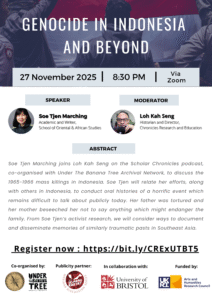
The session opens with moderator Dr. Loh Kah Seng of Chronicles Research and Education introducing the topic of the 1965 mass killings in Indonesia and the importance of oral history in preserving survivor memory. He welcomes Soe Tjen Marching, a Surabaya-born scholar, writer, and composer now based at SOAS, University of London. Her research bridges Indonesian history, gender, politics, and literature, and is deeply shaped by long-term engagement with survivors of the violence. Her work moves between scholarship and creative practice as a way of confronting histories that remain politically sensitive and socially silenced.
Soe Tjen begins with her own family story. Born after her father’s release from prison, she grew up sensing something was wrong but was repeatedly told half-truths. She overheard siblings whispering and learned early that certain questions were forbidden. Only years later, after her father’s death, did her mother reveal the truth that he had been imprisoned as a member of the Indonesian Communist Party and had served on a local committee. The secrecy shaped her childhood and her sense of self. Even her unusual name, “Marching,” turned out to be a quiet political trace, a reference to Chairman Mao’s “The Long March,” chosen by a father who could not speak openly but still wanted to leave a sign.
She describes how prison did not end when detainees were released. Her father lived with severe psychological trauma that surfaced in unpredictable anger and emotional instability. Her mother carried constant fear, worried that any misstep could bring renewed persecution. Economic hardship followed political stigma, limiting opportunities for the entire family. The genocide’s violence continued in private life, shaping moods, silences, and relationships.
The conversation then turns to her Chinese Indonesian background. Ethnic Chinese communities faced compounded vulnerability, often targeted through a mix of racial suspicion and anti-communist hysteria. Yet stigma operated unevenly. In some Chinese communities, imprisonment was understood as part of broader racial persecution rather than purely political guilt. This reveals how race and ideology intertwined, complicating how survivors were treated within their own communities.
She discusses her book The End of Silence, built from years of oral history interviews. Rather than imposing a historian’s voice, she foregrounds survivors’ own words. Interviews happened over many sessions, often in homes or informal spaces, with transcripts revised collaboratively. Survivors frequently minimized their suffering at first, shaped by decades of propaganda and shame. Only slowly did deeper stories emerge, including torture, sexual violence, forced labor, and the long-term destruction of families.
Some stories could not be published as testimony. One woman who became pregnant from rape in prison asked that her story not appear as factual record. With her consent, it became fiction. She argues this is not a distortion but another way of safeguarding truth when direct exposure could cause harm.
She notes that memory is never untouched. Many survivors internalized anti-communist propaganda and repeated state narratives alongside their own experiences. Oral history, in her view, is not about extracting a single, pure truth but about preserving voices that were systematically suppressed. Her role becomes one of negotiation, care, and ethical responsibility.
Her novel, Dari Dalam Kubur is based on these histories and was initially accepted by Gramedia, a major Indonesian publisher, which later demanded heavy cuts. She refused and published it with the independent publisher Marjin Kiri. The book’s multiple reprints suggest a strong appetite for suppressed histories despite ongoing political pressure.
Elderly survivors often insisted on using their real names, saying they had little left to lose and wanted their stories known before death. She made sure they understood the risks. Threats, surveillance, and harassment of activists continue, showing that the legacy of 1965 is not only historical but ongoing.
Her interview practice centers emotional safety. Conversations begin with personal sharing, sometimes her own family story, to create mutual vulnerability. Survivors control what they share and when. This approach resists extractive research practices and treats storytelling as a shared human exchange.
She also highlights the fragility of personal archives. Prisoners wrote secretly on scraps of paper, cigarette wrappers, or leaves, but guards often destroyed these records. The few surviving fragments, preserved by families, are precious traces of voices that regimes tried to erase.
She hopes her work contributes to acknowledgment, justice, and reparations. Many survivors still live in poverty, marginalized by decades of stigma. Her own family’s economic struggles illustrate how punishment extended across generations.
Listening to repeated testimonies of torture and loss took a deep emotional toll. She experienced nightmares and distress but felt a responsibility to keep listening because survivors had carried these memories alone for decades.
Soe Tjen addresses debates about calling the violence genocide. While legal definitions are contested, many scholars and tribunals use the term. She stresses that powerful networks tied to the New Order regime still influence textbooks, media, and political life, preventing full reckoning.
The killings are also placed within Cold War geopolitics. Western governments viewed Indonesia’s political direction with suspicion and supported anti-communist forces. After the massacres, foreign corporations gained greater access to Indonesia’s natural resources. Political repression and economic realignment were closely connected.
She draws a direct line from 1965 to the 1998 anti-Chinese riots, arguing that similar actors, methods, and narratives of scapegoating resurfaced. Sexual violence again appeared as a weapon of terror. These continuities suggest that unresolved impunity allows patterns of violence to re-emerge.
Religious organizations, both Islamic and Christian, were implicated in the killings. Some leaders and members have since acknowledged wrongdoing and called for apologies, but institutional accountability remains limited and often symbolic.
She ends by emphasizing that silence protects perpetrators, not survivors. Breaking silence through storytelling is both painful and necessary. The session closes with thanks and a reminder that research should serve public understanding, not remain confined to academia. Soe Tjen’s work stands as part of a broader struggle to return voice, dignity, and historical presence to those long pushed to the margins.